
Why Could Hitler Restructure Germany?
German people didn’t just vote for him to keep their ordinary lives together. Why?

This week in 1933 - on March 23rd - the German Reichstag enacted the “Enabling Act”, giving Hitler’s every decree the force of law. Fifty-three days after Hitler had been chosen as Chancellor of Germany, he was officially empowered to rule as a dictator.
The other month, I was reading Hitler’s First Hundred Days by Peter Fritzche. It gave me an eye-opening view of just how quickly German society changed after Hitler was given power. Hitler moved swiftly, in a matter of days, to seize and restructure things, and German society changed swiftly along with him.
It wasn’t just a response to Hitler’s individual actions (though ordinary German people did so respond), but an all-encompassing shift of attitude. It wasn’t just out of fear (though there was some of that with some people), but at least in some sense being actually willing to accept his leadership. And, all of this happened (or at least came to the fore) in a matter of days. I appreciate Fritzeche’s repeated echoes of “This was Day Three” (or Fifteen, or Thirty-Two) “of the Third Reich,” reiterating how much had changed in how little time.
By Day 2, Nazi uniforms and flags were already blanketing the country, On Day 24, the Nazi street-fighting militia was deputized as official police - giving the force of law to their regular violence. On Day 36, the Communist Party was outlawed and its leaders arrested. Many more events intervened and followed in almost-breathless succession.
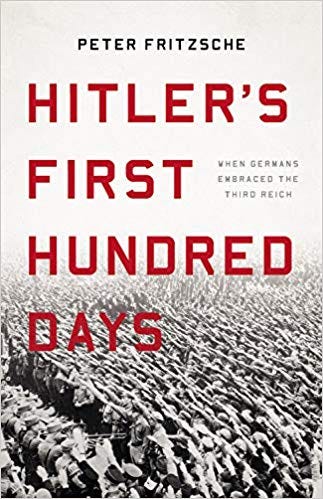
Fritzche shows us how this shift happened. What he doesn’t really go into is the reasons for it. I don’t mean “why were so many people willing to put up with Hitler”; that’s obvious. (I don’t just mean the secret police; I’ll be going into more later.)
As it’s said, the past is a foreign country. Before we try to draw lessons from the past or make comparisons with it, we need to understand it - and doubly so with a place like Nazi Germany which understandably raises so much indignation. So, why did this shift happen as Hitler came to power?
People clearly didn’t just vote for Hitler as a way to keep their ordinary lives together. They totally restructured their lives around him and the Nazi view of society. What I was left wondering is, why?
Naziism isn’t really a coherent ideology.
This shouldn’t surprise us; most Nazis didn’t really care about coherent ideology. They accepted some academic ideas - including many fringe ideas such as Hanns Hörbiger’s “World Ice Theory”1 - and Hitler while in power was happy to declaim over every idea under the sun, but at its core, Naziism simply glorifies power and action rather than specific ideas. Under its umbrella, ideas (such as the World Ice Theory, or Positive Christianity2) could compete with other ideas (such as neopaganism3) in a mishmash of political infighting.
The political infighting also affected military ideas; this is how submarines and battleships and tanks ended up competing for steel and workmen, to the great harm of the Nazi war machine. Of course, this isn’t unique to Naziism - to pick on a contemporary, President Franklin D. Roosevelt also ran his executive branch in a similar way, and I think it hurt his efforts too - but the Nazis took it farther than most.
But the Nazis held some concepts much more centrally than others. One was, as you might expect, racism - but not just ordinary racism, but racism as the center of life and history; the idea that life and history were centrally defined by the struggle between different races. Another idea was that society isn’t a means for individuals to live their lives, but it’s a thing that should be organized and led by one single leader to one single purpose.
Both these concepts demand a radical change of worldview, and readiness for a change of life, in anyone who really accepts them. But most people across Germany did appear to really accept them, within the first hundred days of Hitler’s rule.
Why?
This isn’t quite the same as the related questions of “why did Hitler come to power?” and “why were the German people willing to accept him?”
Many people, at the time and later, have asked those questions. Some scholars have blamed the times, and said it happened in Germany and not elsewhere due to chance, or Germany’s recent history. Other scholars have blamed Germany’s unique path (Sonderweg) through history as a whole - a fundamental flaw in its deep social development.
Both theories have some evidence to them. There’re disturbingly authoritarian trends in the foundation Bismarck gave to the German Empire in the 1860’s-1870’s4. But if I seriously consider whether they’re the cause of Naziism, I follow the lead of Julian Jackson’s argument about the fall of France by saying “similar trends probably happened elsewhere; we just don’t remember them because there weren’t such big events afterwards.”
More recently, the Weimar Republic founded itself after World War I in a way that lent itself to large fractions of society seeing it as illegitimate. The far-left Communists and far-right Nationalists both rejected the Republic - and between them, they frequently got almost half the vote. With nearly half of voters rejecting the Republic’s legitimacy, it was no wonder political society was in an uproar. It was no wonder that President Hindenburg eventually called on Hitler, at the head of the largest far-right antirepublican party, to lead a government: by that point, he couldn’t find another option.
But let’s look deeper. Why were so many German people willing to take on the Nazi worldview so quickly?
In large part, I trace it to the same recent causes that led to Hitler gaining power. The chaos of the Weimar Republic allowed open battles in the streets between paramilitary groups linked to every party. Even the centrists had their own paramilitary - because they needed it to defend themselves!
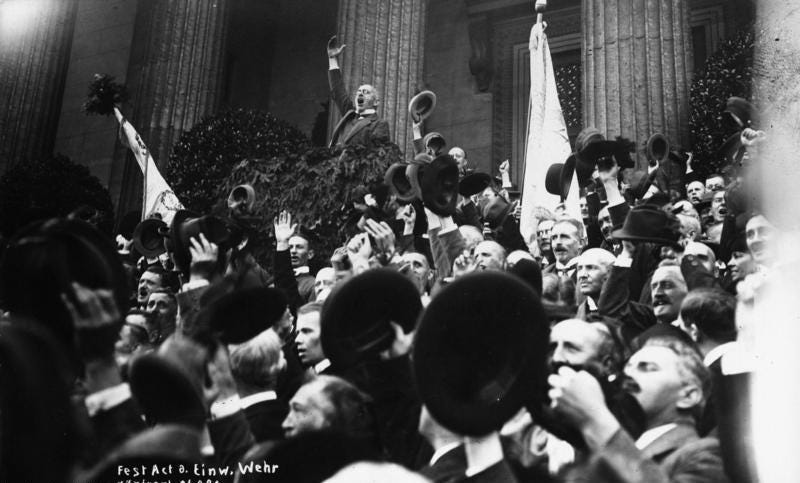
After years of this, it was no surprise people were willing to vote the Republic away... and perhaps also no surprise they were open to the idea that society as a whole should be organized for a common purpose.
Also, more deeply, it makes sense - after this chaos, and after what they saw as the illegitimacy of the Republic - that people would look back to the last time they did have a common purpose. For many of them, that was World War I. Most German men had served in the army, and many if not most remembered it with pride. Both in the army and on the homefront, society had been organized for the war. And then, the whole war effort went down in ruinous defeat. It had been betrayed, the Nazis and other nationalists insisted, by the Republic’s founders. Regardless, if Germany could only pull together again, they could do it again - and, this time, win!
It was a compelling vision, doubtless, to someone who looked back on the war years with nostalgia and didn’t like his postwar life.
What’s more, the Weimar Republic’s huge political divides - even before the rise of the Nazis - left people aware that there was an unsettled choice between different visions for the world.
Historically, in the United States or Britain any time in the last centuries, or other countries during times of stability, most people have been aware more or less what the country is, and more or less bought into that vision for it. Whether or not someone in the 1950’s United States was happy with things, he knew how things were, was reasonably confident that (absent nuclear war) they’d stay that way, and was ready to live a life within that system. Many people (from McCarthy to the NAACP) wanted reforms, but they were reforms that would be done within the system. If someone with a radically different vision took power, that would seem like a huge change, and the new ruler would need to work hard to convince people things were worth the disruption the change caused to everyone’s life and plans.
When that isn’t so much the case in a republic, that’s a problem.
In Weimar, through most of its life, that wasn’t the case. People could see the Nationalists and Communists both rejecting the system and demanding fundamental changes. There was no republican tradition to weigh against this; even the youngest person voting in the last Weimar election could remember the Republic being first proclaimed in 19185. Change was a very real possibility to them. There was very little tradition for them to believe in. There was no reason to believe in the Republic or buy into its vision unless you really wanted to.
And, the Nazis were the ones best-prepared to capitalize on this, with their energetic vision.
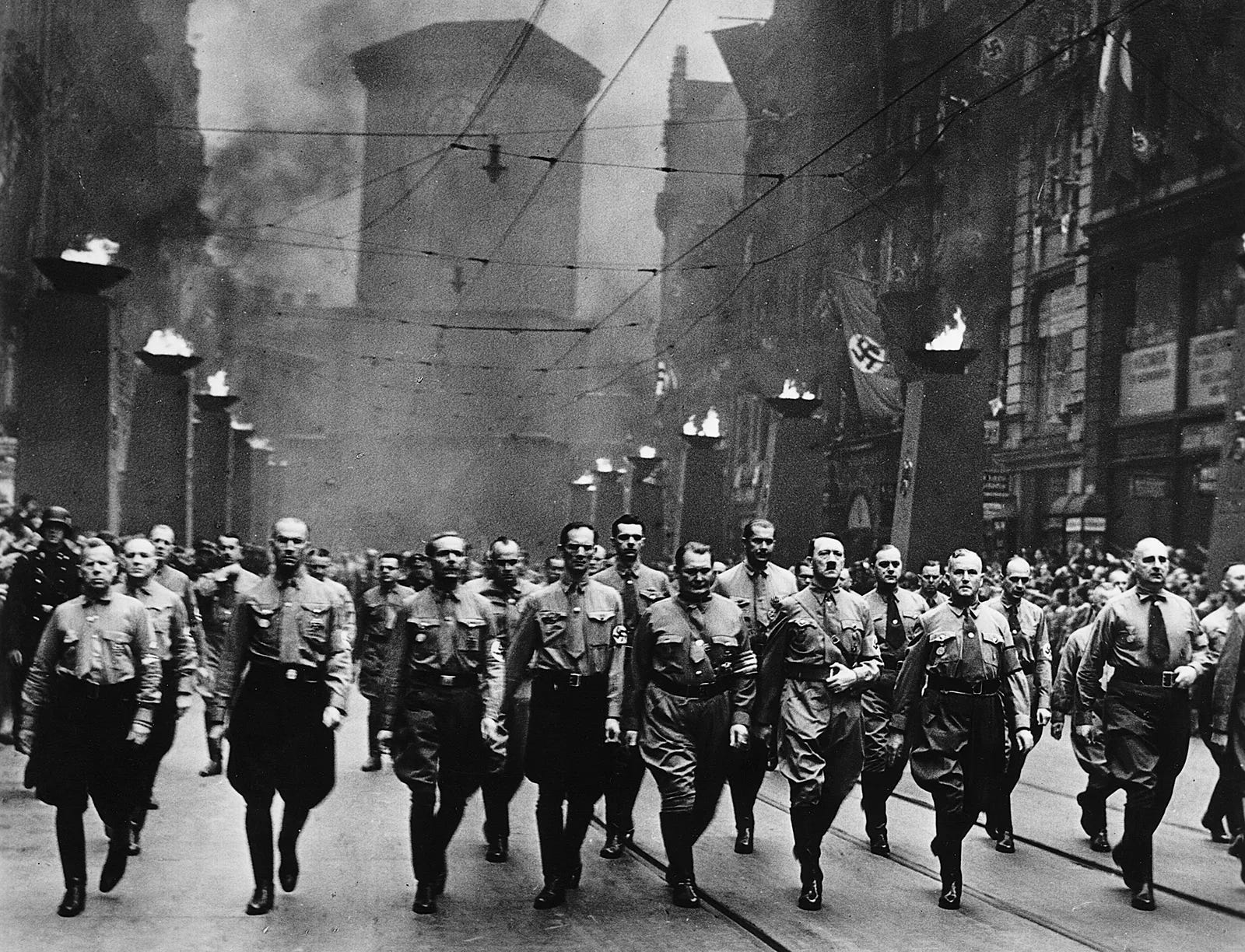
To make this worse, the paramilitaries weren’t the only division between parties in the Republic. Different political parties had their own social organizations, their own bars, their own vacation sites, and more. People were used to living a lot of their lives inside a political group, and less used to interacting with outsiders. All this was already happening when the Nazis were just a tiny local party. This destroyed civic society, or channeled it inside political groups, which is also a bad thing for a republic.
And on top of that, these weren’t usually independent groups that had just attracted a politically-aligned clientele; they were branches of the organized political parties themselves. The Social Democratic tennis club in some town would be reporting up the chain to the national party organization. When the Nazis organized all life around the Nazi Party, that wasn’t an unprecedented thing to Germans.
I still struggle to imagine how swiftly people joined in as the Nazis restructured German life. These are the answers that came to me as I searched for answers, and I do think they help explain it... but they don’t fully satisfy me either.
Regardless, these do point to some danger signs. Fortunately, a lot of the signs are - if not unique to Germany - at least rare. History rarely repeats exactly. But individual aspects often do repeat... and some of these causes are likely to recur.
God willing, they won’t lead to a similar outcome again.
The World Ice Theory was a pseudoscientific idea where the prehistoric Earth had multiple ice-moons in sequence, each of which had in turn spiraled in to collide with the Earth and form much of the geological strata.
“Positive Christianity” was an idea that rejected the Old Testament of the Bible, rejected Jesus’ Godhood, said Jesus was fathered by a German, and viewed an ethnic homeland in this world as more important than salvation in the next. Nevertheless, they claimed to be Christians. These ideas failed to gain popularity even among those Christians who followed the Nazis.
The Nazis weren’t pagan as such (or followers of any other ideology), but there were some prominent Nazis who did engage in pagan rituals or an imitation thereof.
I count the North German Confederation as part of the foundation of the Empire.
The Weimar Constitution gave the vote to everyone twenty years old and up, so that person would’ve been five and a half in November 1918. Their earliest memories would have been during the war. Later on, this person would have been twenty-six when Hitler started another war, young enough to be drafted into it.
Worth noting is that part of the Weimar Republic's legitimacy issues stemmed from the fact that almost immediately after it formed it signed the armistice with the Allies that ended the fighting part of World War I, then got stuck with signing the Treaty of Versailles, so the German people blamed it rather than the Second Reich and the German High Command for losing it.
One wonders what might have happened if the Kiel mutiny hadn't happened and the war dragged on into 1919, ending with the Kaiser having to sign surrender terms in Berlin.