
Independence Day
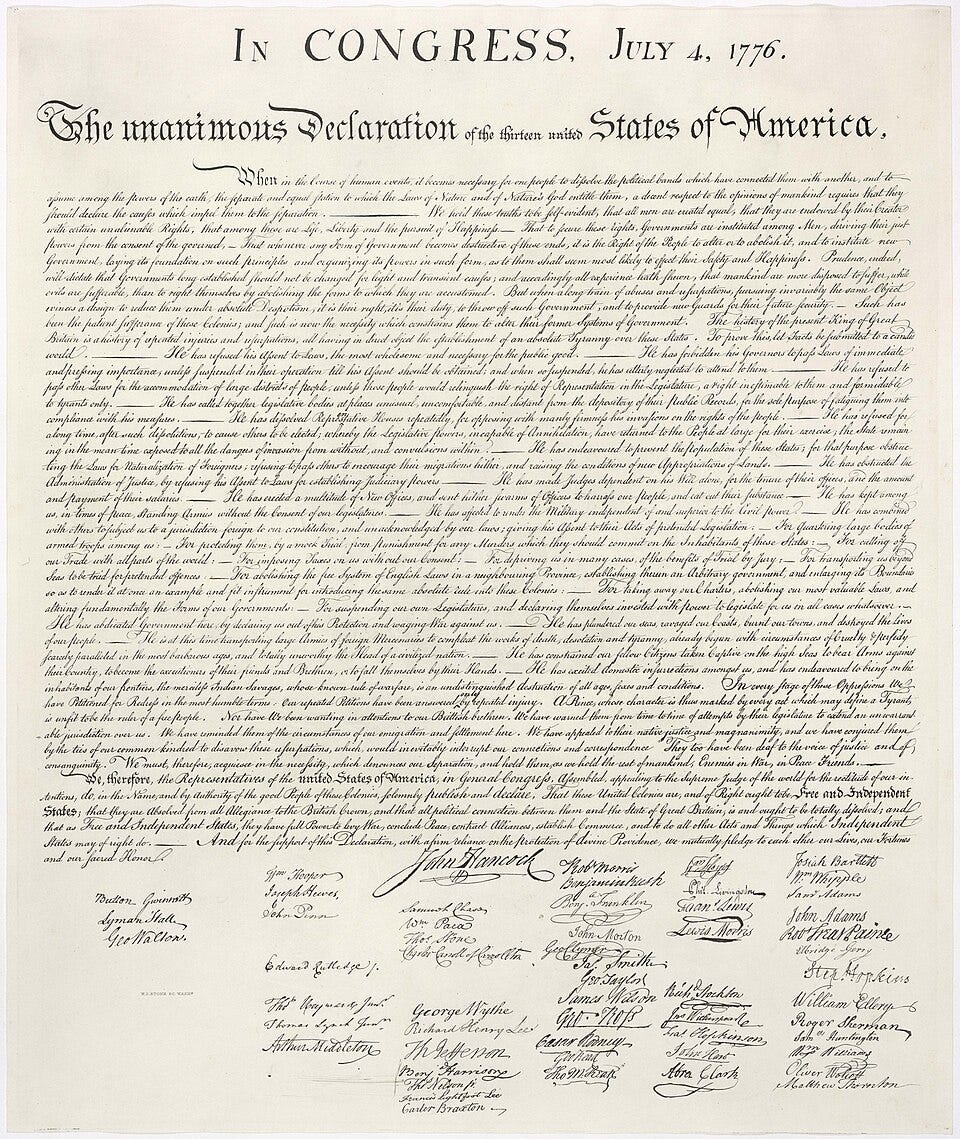
We hold these truths to be self-evident

On July 4th, 1776, the United States of America formally declared their independence.
Last month, I was writing about the Declaration itself and how Jefferson and the Continental Congress wrote it. But as I pointed out there, the Declaration of Independence doesn’t just declare America independent. It doesn’t just spell out the wrongs done by King George and the British Parliament. It doesn’t found American independence on anything specific to America.
Rather, the Declaration squarely declares independence on the basis of “self-evident” truths which apply universally:
We hold these truths to be self-evident: that all men are created equal, that they are endowed by their Creator with certain unalienable Rights, that among these are Life, Liberty and the pursuit of Happiness.— That to secure these rights, Governments are instituted among Men, deriving their just powers from the consent of the governed, — That whenever any Form of Government becomes destructive of these ends, it is the Right of the People to alter or to abolish it, and to institute new Government...
If this is true in America, it’s just as true in Europe or Africa or Asia or anywhere else.
When Congress passed Richard Henry Lee’s naked resolution on July Second, it declared America independent. It was two days later, on the Fourth, when they concluded the full Declaration. And ever since then, we’ve - rightly - chosen to celebrate independence on the “Glorious Fourth.” We celebrate not just the fact that the United States are independent, but the principles behind declaring our independence.
Let tyrants shake their iron rod,
And Slav’ry clank her galling chains,
We fear them not, we trust in God,
New England’s God forever reigns.-- “Chester“, William Billings, 1770
Ever since it was first written and read to the States and the world, the Declaration of Independence has shone through history as the shining example of American principles.
America’s Constitution in its specifics hasn’t been much of an example. Few nations have chosen to copy it, and I’m not blaming them. At least, few have done so with good results. In countries with a weaker republican tradition than America, I suspect, America’s powerful President can too easily become a dictator.
This shouldn’t be surprising; when the Founding Fathers framed America’s Constitution (twelve years after independence) they looked at British history, missed the rise of the Prime Minister and Cabinet (which was still in progress at the time), and took the wrong lesson from how the king had lost power through history. Most countries since then have looked more to the British parliamentary system and Prime Minister as they eventually did develop - and I can’t blame them; that’s the main thing the Founding Fathers looked to, but simply from a better vantage point.
The lesson that can be taken from America’s Constitution isn’t the details of the Constitution. it’s the concept of a constitutional convention, the Bill of Rights, and the concept of thoughtfully designing a government itself. As for the precise details - America didn’t get them right on the first try either, and the Founding Fathers would’ve been the first to admit the Constitution of 1789 was also imperfect.
Instead, what the American Revolution gave to the world was the Declaration of Independence.
It isn’t that the Declaration said anything new. It was that it crystalized the points from Locke and other philosophers and attached them to a living example. It was one thing to speculate that the people had the right to “alter or abolish” their governments and create new ones charged to protect their “inalienable rights”; it was another thing to “be submitted to a candid world” not just the words but an actual country that had done so and prospered.
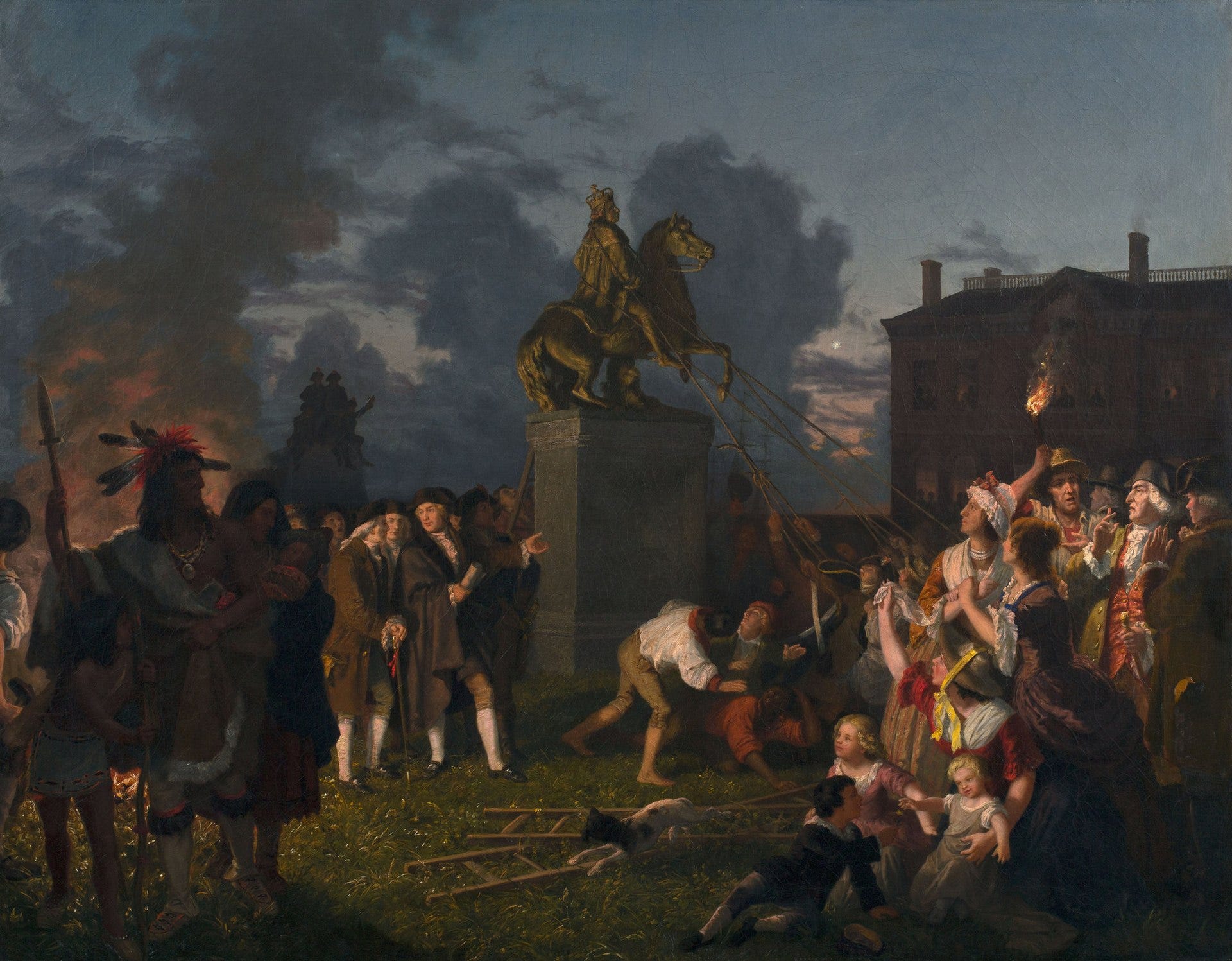
As Abraham Lincoln put it in 1857, the Founders “did not mean to assert the obvious untruth, that all were then actually enjoying that equality.” But when they wrote the Declaration, “they meant to set up a standard maxim for free society, which should be familiar to all, and revered by all; constantly looked to, constantly labored for, and even though never perfectly attained, constantly approximated, and thereby constantly spreading and deepening its influence.”
It hasn’t been “perfectly attained” even in America - not in Jefferson’s day, not in Lincoln’s, and not in ours. But we constantly continue looking back at the Declaration as “a standard maxim,” and looking around at our present day striving to make it more true.
And because of that, America is a living example - a “city on the hill,” as the Puritans whom we take as our national ancestors called it, in words taken from the Bible - showing that the Declaration of Independence could work in real life. As Abraham Lincoln put it in 1861 as he passed through Philadelphia on the way to take up the Presidency:
I have often inquired of myself, what great principle or idea it was that kept this Confederacy so long together. It was not the mere matter of the separation of the Colonies from the motherland; but that sentiment in the Declaration of Independence which gave liberty, not alone to the people of this country, but, I hope, to the world, for all future time. It was that which gave promise that in due time the weight would be lifted from the shoulders of all men. This is a sentiment embodied in the Declaration of Independence.
Before Lincoln, Frederick Douglass had praised their “sublime faith in the great principles of justice and freedom” which “seized upon eternal principles, and set a glorious example in their defence”, demanding only that it be extended as far as its principles proclaimed. Much later, Martin Luther King Jr. likewise called on America to “live out the true meaning of its creed ‘We hold these truths to be self-evident, that all men are created equal.’”
All ages shall speak with amaze and applause,
Of the courage we’ll show in support of our Laws;
To die we can bear, but to serve we disdain.
For shame is to Freedom more dreadful than pain.— “The Liberty Song“, John Dickinson, 1768
Beyond America, the Declaration has been echoed by people the world over. In 1945 while the city of Philadelphia was campaigning to be the home of the United Nations, they called Independence Hall a “shrine” that is “recognized throughout the world as the birthplace of political liberty and democracy.” They were not wrong.
Not two decades after the Declaration of Independence, France likewise rose in revolution, looking to America as its inspiration and cheering on Lafayette the French hero of the American Revolution. Their revolution failed - falling first to bloody violence and then to tyranny and then to foreign invasion - but nothing in America’s principles says that they’re easy to live out. Ever after, Frenchmen kept looking back on that Revolution’s principles and striving to bring them into truer and less bloody reality.
Since then, America, and the Declaration of Independence specifically, has kept inspiring people the world over. The Mexican Declaration of Independence, Philippine Declaration of Independence, Irish Declaration of Independence, and many more echo its wording. They saw in the American Declaration of Independence principles they too held self-evident, and they too chose to recognize and found their independence on those same principles.
We might fault how they lived up to those principles far worse than the United States (Mexico quickly fell to monarchy and dictatorship), or we might fault their prudence (the Philippines were shamefully suppressed by the United States in gross violation of our mutual founding principles), or we might point to other faults in how they started their countries (someday I want to write about the sorry and complicated situation of the Irish Civil War). But I can’t fault the principles they chose to aim at.

The Founding Fathers had similar doubts about America.
It’s said that Benjamin Franklin quipped when Congress was signing the Declaration, “we must all hang together, or assuredly we shall all hang separately.” Whether or not he actually said it - it was a common quip before his day - it was definitely applicable. Another member of Congress, Carter Braxton (who thought the Declaration premature but did sign it), said something very similar in an April letter. Braxton and Franklin and everyone recognized there was a real chance that the Revolution would fail, independence would be stillborn, and everyone who signed the Declaration would be hung as a traitor.
Indeed, the same day Congress voted for independence - July 2nd - the first elements of the British army landed at Staten Island. The British would take New York City, capture Philadelphia, and send Congress running for fear of their lives. It would be, as Thomas Paine put it, “times that try men’s souls.”
But their fears did not come to pass. After years of struggle, the Revolution was won. The “self-evident truths” had been worked out in the real world.
And afterwards, there was never again a serious chance America would cease to be independent.
But the Declaration went beyond mere independence to proclaim grand ideals - and those ideals would long remain in doubt. In some sense, they’re still not proven today. Franklin did say twelve years after the Declaration, during the Constitutional Convention when a woman asked him in the street which system of government they were preparing for America, it would be “a republic, if you can keep it.”
Many at the time thought America would not keep it. Many thought George Washington would take a crown, or that the states would degenerate into squabbling mobs, or that the new federal government would turn into a dictatorship, or that a majority of one faction would run roughshod over the “inalienable rights” of the minority. Most of this hasn’t happened, and when it has, it’s often been cured by an America that has kept looking back to those same ideals.
Lincoln said the Civil War was “testing whether that nation, or any nation so conceived and so dedicated, can long endure.” It wasn’t just the Civil War; most of American history has been that test. So far, we have passed. But the test is still before us.
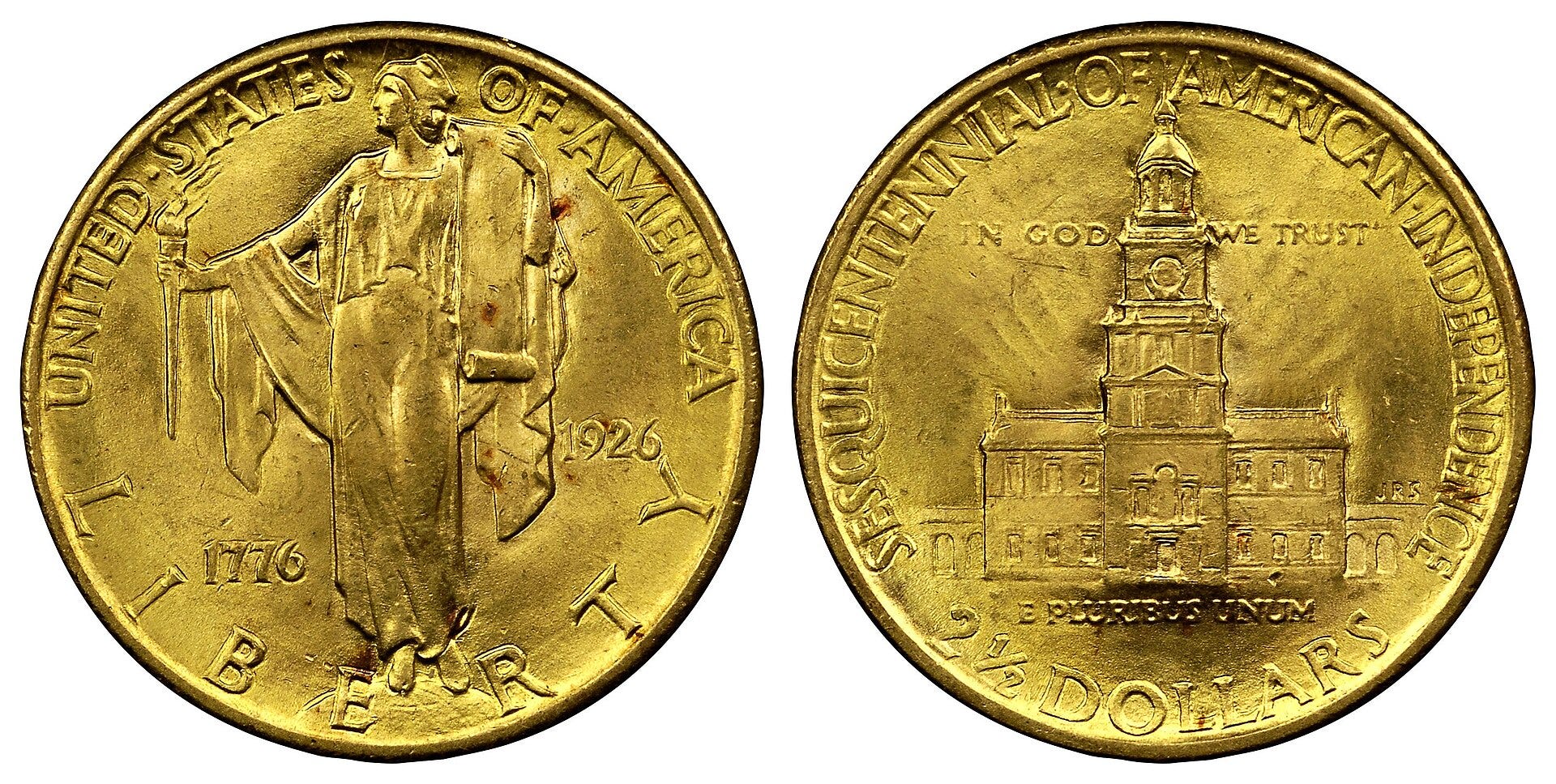
Today is the bisesquicentennial of the United States of America.
At first, not everyone agreed when the United States came to exist. Thomas Paine dated his April 1777 pamphlet in “this fourth year of the UNION, which God preserve” - dating it to the start of the first Committees of Correspondence in 1772. But officially, it was quickly decided, the United States of America came to exist on July 4, 1776.
A hundred years ago today, on the sesquicentennial of American independence, President Calvin Coolidge said in Philadelphia words which should resound in our memory today:
It is often asserted that the world has made a great deal of progress since 1776, that we have had new thoughts and new experiences which have given us a great advance over the people of that day... But that reasoning can not be applied to this great charter. If all men are created equal, that is final. If they are endowed with inalienable rights, that is final. If governments derive their just powers from the consent of the governed, that is final. No advance, no progress can be made beyond these propositions. If anyone wishes to deny their truth... their ideas are not more modern, but more ancient, than those of the Revolutionary fathers.
On the finality of those principles, our Founding Fathers pledged “our Lives, our Fortunes and our sacred Honor.” For their monument, we can look around at America and at the world.
Torn from a world of tyrants
Beneath this western sky
We formed a new dominion,
A land of liberty;
The world shall own we’re freemen here,
And such will ever be,
Huzza, huzza, huzza, huzza
For love and liberty.
-- “Free America“, Joseph Warren, 1774